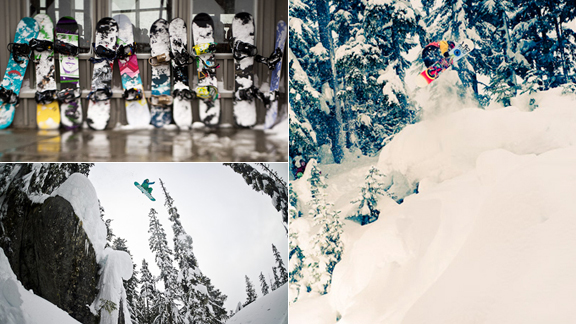
Zimmerman/Scarth/Strain
Flat-light, stormy conditions aside, it looks like it was pretty fun out there...
When people flip through the pages of a snow publication and pause on a particular photo, one of the details in the image most commonly overlooked is the name of the photographer. The eye of the general populous has little possibility to be pulled from the action and take notice the micro-sized photo credit hidden in the images corner, or in the shadow of the magazine's spine. The shooter who worked equally as many draining hours to capture the image as the athlete has no face.
Regardless of the insufficient acknowledgment, as long as people keep buying magazines, photographers will keep shouldering 40-pound packs into the backcountry, standing for hours with frozen toes-- fingers numb, out of gloves to keep lenses from fogging, to make sure flashes fire -- all for the sake of trying to make snowboarding and skiing appeal to overstimulated subjects who are increasingly less interested in media that does not allow users to interact by way of a mouse or remote control.
Why do snowboard and ski photographers bother? Because they love snowboarding and skiing. I believe more so than many of the professional athletes they take pictures of.
The Deep Winter Photo Challange, hosted by Whistler Blackcomb, is the battle of six professional photographers who are given 72 hours to shoot in the middle of what Whistler considers their "storm season" -- otherwise known as January. The photographers present a slideshow of their best work from the three days at the end of the shooting window to a mass of photo-enthusiasts, and regardless of crowd reaction, the final results are voted on by a panel of judges.

Just taking part in a competition alongside guys like Scarth and Zimmerman was a huge honor for a new guy like me. Taking home third place was icing on the cake!
-- Andrew Strain
The contest is designed to put the focus and glory onto the photographer, pitting the shooter's creativity and equipment against the most paining and difficult conditions of winter. Athletes for the three day photothon are picked by the photographer, all images required to originate from inside the boundary lines of the Whistler Blackcomb ski resort. The Deep Winter event has yet to see a high-pressure system in the five years it's run. (It snowed almost three feet by the time the 72 hour window had expired.)
Tim Zimmerman, the only non-Canadian photographer selected to compete this year, asked, Temple Cummins, myself, and fellow Mervin shredder Forrest Burki to join him for the shootout last week.
 Andrew Strain
One of the shots that made Andrew Strain a winner.
Conditions during the photo hunt varied from snow so light and loose that two feet of new had you sluffing to the base on every steep pitch, across the spectrum to rain. Against five photographers who call British Columbia home -- most notably, Blake Jorgenson, a 20-plus year native of Whistler who owns a gallery in the village and ended up winning the event -- our team was at a serious disadvantage. Without local knowledge of terrain it became necessary for us to hire a guide.
The Whistler and Blackcomb mountains are so vast you could spend a lifetime searching for good, photo-worthy terrain and most likely overlook a fair share. Fortunately for us Canadian freeride legend Shin Campos came to our assistance, and lead us into some zones that only someone with years of Whistler resort-riding experience would know to access.
Jorgenson took home the trophy and was crowned "King of Storms" for a slide show that went far beyond the mountain and into the lives of the athletes he was working with. (Most intimately, skier Dan Treadway and family.) Second place went to Robin O'Neill, the first female competitor to take on the Deep Winter Challenge. Her slideshow focused on the relationship of pro patroller/mother and her freeskiing daughter, and was without doubt the most emotional of the evening. "Pulled on the heart strings," said Temple.

John ScarthDave Kelleher at the end of Day two, with no legs left and only the promise of Dusty's pitcher's keeping us going.
Third place went to BC local Andrew Strain, who has an undeniably vast understanding of the multitude of terrain options available for slaying Whistler Blackcomb on a storm day. Best photo in show went to Ilja Herb.
Jon Scarth, photo editor for Snowboard Canada Magazine, and Tim Zimmerman -- one of the more accomplished snowboard photographers to slide down a mountain -- both had incredible edits. (To see Scarth's full edit,
click here.) I feel their presentations would have been better received by more rounded panel of judges. Two ski magazine photo editors, plus four photographers who primarily ski and shoot skiers seems an unbalanced platform to judge a photo contest consisting of both ski and snowboard photography. Need a few snowboard judges in there -- people who consider a skier crossing their tips a case of pigeon toe.
Skiers and snowboarders see photos differently, and are turned on by a different aesthetic. To illustrate, the "best photo" of the competition was of a skier pulling a backscratcher tip cross -- I think it could have been the best photo in the show if the skier had one less ski on and was standing on it sideways in a tail-whip position. Pigeon toe can lead to clubfoot.
After the awards, presented to 1,200 people at Blackcomb's swank Fairmont Hotel, I had a brief opportunity to talk with Jorgenson. His first time competing in the event, he gave me a little insight into the competition from his winning end:
"Being able to do it at on your home mountain is just very natural. You don't have to think to hard; it just flows out of you. You know where everything is, where to go. The whole thing is designed to push the limits, to work in conditions, and on days that you might not normally shoot. The photographers give it their all, and the end product -- this show -- is amazing."